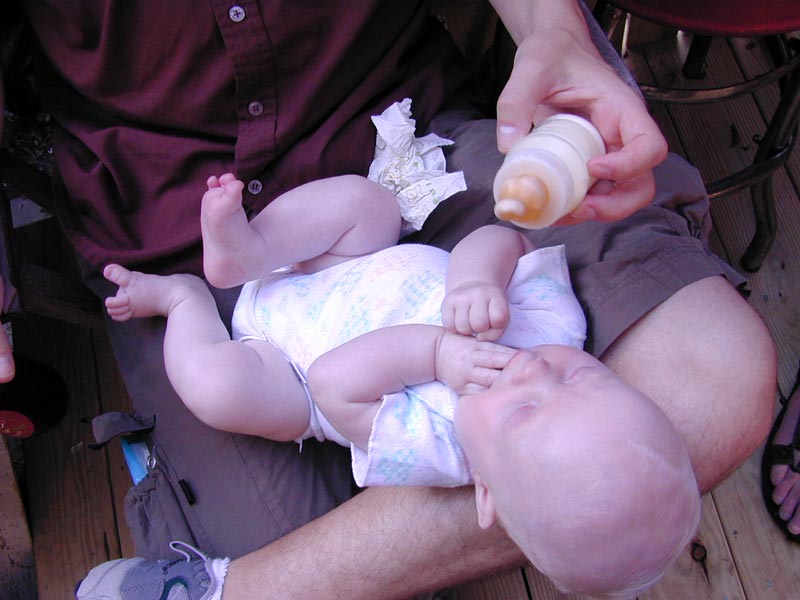
I recently read an article about parents overfeeding babies. When I first realised I was expecting a baby, one of the first thing Bilal and I discussed was what we would do regarding feeding habits when the baby arrived. Obviously, it is good for new parents to have aligned attitudes about things involving children. We agreed that feeding habits would be consistent for the initial period in the baby's life, as it is important for babies to get the food they need to grow properly. No diligent parents would want to leave their children malnourished.
However, we agreed that at a certain age, there would be divergence according to gender. Ideally, if our baby had been a girl, the first expression she would learn would not be "oui", "non", "papa" or "mama", but "la moitié, s'il vous plaît". As indicated by the book "Why French children don't talk back" by Catherine Crawford, we French know a thing or two about how to raise children. We like to get our children into good habits early on and beauty is one of the primary ways I plan to do this with any daughters I have: - I don't want them to grow up looking fat and ugly.
There is all sorts of talk in the Anglo-Saxon world about how women are bombarded with unrealistic images of what women should look like, to the extent that they have tried to make fat women legitimate by introducing a "curvy Barbie". Apart from the fact that cartoon (or otherwise not-real) characters are exaggerated in how they are constructed, I think they should be ashamed of themselves for encouraging women to get fat like that! With any daughters I have, I plan to promote the skinny ideal to them so they grow up to look like a pretty Frenchwoman, not a fat and dumpy Anglo-Saxon woman! Quelle horreur!
However, none of this matters to us at present, as our baby turned out to be male. To me, my ideal situation would be for him to grow up with the suave urbane sophistication of a traditional Frenchman, but with all the ruggedness and muscularity of Bilal, who plans to teach him how to run the farm he recently purchased in the mountains to the north of Marseille, making visits to his family's farms in Mali where possible to teach him about farming in an extreme climate. I have no doubt that Bilal will want to introduce him to La Savine's culture, which I admit I have some reservations about, but I know Bilal will be more than capable of protecting him. I have no doubt that our son will be irresistible to women if he manages to acquire both French sophistication and Malian ruggedness!
Anyway, if he is to have all these things, he will need a large food intake. My food intake is fine, as I have a medium-intensity exercise routine (not considering using the lift unless my destination is more than 20 floors away and walking as much as possible). However, our son will need more than that, so I am thinking of how to expand his dietary repertoire beyond Bilal's chicken and jollof rice! MDR! French cuisine has plenty of options for accomplishing muscle growth with high-calorie diets: - there are lots of dairy, meat and fish products that have been discussed in previous articles. There are also lots of nice healthy fats in the area around Marseille, most notably olive oil, which will enable him to fulfil his calorific requirements without putting undue strain on his heart.
Anyway, all that is a long time away and I am still getting used to baby stuff!
Welcome to Impossibly Dainty French Woman, the The #1 blog dedicated to explaining to women worldwide how to be impossibly perfect like we Frenchwomen and enjoy the French lifestyle, be it the trains or beautiful cities, but most of all the cuisine that facilitates us in our quest to remain pencil-thin. Please subscribe to this blog to receive updates by e-mail (below).
Showing posts with label sophisticated. Show all posts
2016-06-06
Getting into good habits early on
Labels:
baby,
barbie,
bilal,
catherine crawford,
chicken,
curvy,
desert,
farm,
feeding,
horreur,
jollof rice,
mali,
Marseille,
olive oil,
overweight,
rugged,
skinny,
son,
sophisticated,
suave
2014-02-01
Coeliac disease is no longer a yuppie illness
Over Christmas, Bilal had some very strange times. Being my new boyfriend, he was invited to spend Christmas with my family, given that his gormless family members don't celebrate this occasion. I remember when my mother invited him over. He seemed very unenthusiastic, but my mother persisted and he agreed to spend Christmas with us reluctantly. I stayed in my own flat while he stayed with my parents. I was enthusiastically looking forward to having Les Treize Desserts, that great Provençal equivalent of a smörgåsbord.
One of the things that has been regarded as extremely odd about Bilal is his refusal to eat any local French cuisine. There are a few specialist shops in or near La Savine selling traditional Malian products and Bilal always refused to eat anything other than traditional Malian cuisine and nobody had the faintest idea why. Our church is one where people tend to stay the whole day. Given Bilal's responsibilities at church, it was not really practical for him to go back to La Savine and come back again for his next task, so he would bring in a packed lunch, perhaps eating it in a room out of sight. Even on House Party, he would insist on bringing his own food and he would cook it himself if need be, setting up a fire to cook taguella, a traditional Malian bread, which tends to be cooked in sand and ashes.
During the various meals at Christmas, Bilal was constantly trying to make excuses not to participate in mealtimes, saying that he didn't have much of an appetite. In France, this is quite normal for women with dainty figures such as myself, MDR. However, it is not normal for a man to have no interest in food: - as I have explained in a previous posting, if a Frenchman is overweight, it is regarded as a sign that he is living the good live. Anyway, Bilal found that there was no way to avoid eating food at my parents' home without seriously offending those who had cooked it, so he reluctantly ate the food available. I did not witness the events of the early hours of Christmas Day, as I was sleeping in my own flat after the midnight celebrations of Christmas Eve. However, when I arrived on Christmas Day, I saw Bilal walking towards the door of my parents' home in order to leave and looking very upset and humilliated. There was quite a commotion of people trying to persuade him to stay. What apparently happened is that in the early hours of the morning, he had some extremely violent bowel problems and unfortunately, because the bathroom is not soundproofed, he was not able to hide the sounds resulting from these violent bowel problems and he made very loud moans of pain. Toilet humour is not exactly to a French woman's taste, so I will bypass some of the details.
After a lot of persuading from me and my parents, Bilal eventually agreed to stay. This he did for a few further weeks and he ate whatever food was in front of him (and continued having the same bowel problems). One of my relatives who is known for being a hypochondriac happened to be staying with us this Christmas. She spoke with Bilal and persuaded him to see a doctor. Bilal is quietly a macho man, as he is used to surviving in harsh conditions in the Sahara Desert facing down threats to his family's livestock, be they wild animals, armed raiders, lack of water etc, so he wasn't all that enthused by a visit to the doctor. However, after a very large amount of persuasion, he agreed to visit the doctor. The doctor took a blood sample from him and told him to visit for a follow-up appointment to discuss the results after the sample had been tested.
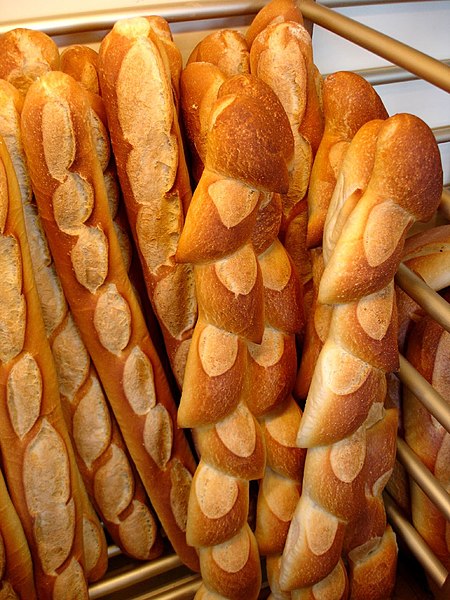
I don't personally know what I would do if I had coeliac disease myself. I would struggle to abstain from all those foods with gluten in them that make French cuisine so sophisticated. Granted, not all French recipes have gluten in them: - tartiflette and cassoulet are two examples I have discussed in previous blog posts that don't normally contain gluten. However, I would struggle to do without my morning baguette: - a micro baguette of course. One can buy large French sticks like the ones in the photo above. However, as Mireille Guiliano agrees, the optimum size of a portion of bread for a sophisticated Frenchwoman such as myself is about the size of an old cassette tape. Gosh, I feel so old, given that I can remember these! Still, as Zoë Williams correctly points out (grudingly and somewhat sarcastically), we Frenchwomen excel in all of life's seasons, whether it be the young filly season or the old bag season, tee hee.
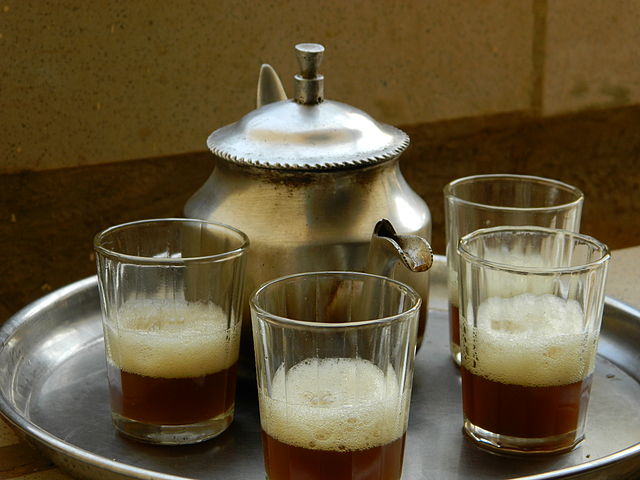
Anyway, enough about that silly woman! Bilal has introduced me to various aspects of Malian cuisine and some of it, though nowhere near as sophisticated as French cuisine, at least appears to be vaguely edible. I am particularly curious about the way tea is drunk. Normally, what happens is they pour the tea from a great height into the pot several times over. Supposedly, this enhances the flavour, but even my sophisticated French palate can't tell the difference, so I have no doubt that this is made up. It isn't as sophisticated as Mariage Frères tea, but it is just about bearable. Still, if I get married to Bilal, I will have to make some adjustments: - it won't do for him to be in bed alongside me and having bowel problems! MDR!
So there you have it: - coeliac disease is definitely not a yuppie disease (along the lines of man flu), as I indicated in a previous blog posting about gluten intolerances, tee hee! Bilal is about as un-yuppieish (yes, I acknowledge there is no such word) as you can imagine. Granted, some Anglo-Saxon yuppies like to spend ages reading medical textbooks and therefore induce symptoms psychosomatically, but occasionally, there are genuine cases of food issues and Bilal is one such example. All you yuppies out there, stop pretending you have diseases you don't really have! It makes a mockery of the people who really do have them!
One of the things that has been regarded as extremely odd about Bilal is his refusal to eat any local French cuisine. There are a few specialist shops in or near La Savine selling traditional Malian products and Bilal always refused to eat anything other than traditional Malian cuisine and nobody had the faintest idea why. Our church is one where people tend to stay the whole day. Given Bilal's responsibilities at church, it was not really practical for him to go back to La Savine and come back again for his next task, so he would bring in a packed lunch, perhaps eating it in a room out of sight. Even on House Party, he would insist on bringing his own food and he would cook it himself if need be, setting up a fire to cook taguella, a traditional Malian bread, which tends to be cooked in sand and ashes.
During the various meals at Christmas, Bilal was constantly trying to make excuses not to participate in mealtimes, saying that he didn't have much of an appetite. In France, this is quite normal for women with dainty figures such as myself, MDR. However, it is not normal for a man to have no interest in food: - as I have explained in a previous posting, if a Frenchman is overweight, it is regarded as a sign that he is living the good live. Anyway, Bilal found that there was no way to avoid eating food at my parents' home without seriously offending those who had cooked it, so he reluctantly ate the food available. I did not witness the events of the early hours of Christmas Day, as I was sleeping in my own flat after the midnight celebrations of Christmas Eve. However, when I arrived on Christmas Day, I saw Bilal walking towards the door of my parents' home in order to leave and looking very upset and humilliated. There was quite a commotion of people trying to persuade him to stay. What apparently happened is that in the early hours of the morning, he had some extremely violent bowel problems and unfortunately, because the bathroom is not soundproofed, he was not able to hide the sounds resulting from these violent bowel problems and he made very loud moans of pain. Toilet humour is not exactly to a French woman's taste, so I will bypass some of the details.
After a lot of persuading from me and my parents, Bilal eventually agreed to stay. This he did for a few further weeks and he ate whatever food was in front of him (and continued having the same bowel problems). One of my relatives who is known for being a hypochondriac happened to be staying with us this Christmas. She spoke with Bilal and persuaded him to see a doctor. Bilal is quietly a macho man, as he is used to surviving in harsh conditions in the Sahara Desert facing down threats to his family's livestock, be they wild animals, armed raiders, lack of water etc, so he wasn't all that enthused by a visit to the doctor. However, after a very large amount of persuasion, he agreed to visit the doctor. The doctor took a blood sample from him and told him to visit for a follow-up appointment to discuss the results after the sample had been tested.
When Bilal returned for his follow-up appointment, the doctor asked his permission to refer him to the local hospital for a biopsy, as the blood sample confirmed suspicions that there were antibodies present. Bilal was a bit apprehensive, but he agreed, as he felt that if there was something wrong with him, he may as well stick the course and find out. I remember accompanying him to hospital for the biopsy and seeing how nervous he was, even though a biopsy is a reasonably routine surgical procedure. In this case, it involved pushing a tube all the way through his digestive system and scraping out a sample of his lower intestine. The sample was later analysed to see if the villi had been blunted on account of inflammation, as in the picture below.
When Bilal visited the doctor again, the doctor informed him that he has coeliac disease (spelled "celiac" by silly Americans who like to murder the English language). Coeliac disease is an autoimmune condition in which ingestion of gluten causes the villi in the lower intestines to become inflamed. It is lifelong and there is no way of treating it; one can only prevent the negative effects thereof by not eating gluten, which is found in wheat, barley, rye and spelt. All this perfectly explains why Bilal never liked deviating from normal Malian cuisine. Malian cuisine, particularly in the north, is not completely free of wheat, though Bilal comes from the area around Timbuktoo, which is further south. The foods he tends to eat include taguella (a bread made out of millet flour), rice, beef, mutton, goat, chicken, baobab leaves, spinach, jollof rice, fufu (no, this has nothing to do with men being camp, in spite of how its name sounds), maafe etc. These foods are not sophisticated in the opinion of a stylish Frenchwoman like myself (at least in the way they are prepared in Malian cuisine), but unknowingly, it appears that they allowed Bilal to live with coeliac disease for so long. He abstained from French cuisine (in which gluten features so heavily), as he found it inflamed his bowels.I don't personally know what I would do if I had coeliac disease myself. I would struggle to abstain from all those foods with gluten in them that make French cuisine so sophisticated. Granted, not all French recipes have gluten in them: - tartiflette and cassoulet are two examples I have discussed in previous blog posts that don't normally contain gluten. However, I would struggle to do without my morning baguette: - a micro baguette of course. One can buy large French sticks like the ones in the photo above. However, as Mireille Guiliano agrees, the optimum size of a portion of bread for a sophisticated Frenchwoman such as myself is about the size of an old cassette tape. Gosh, I feel so old, given that I can remember these! Still, as Zoë Williams correctly points out (grudingly and somewhat sarcastically), we Frenchwomen excel in all of life's seasons, whether it be the young filly season or the old bag season, tee hee.
Anyway, enough about that silly woman! Bilal has introduced me to various aspects of Malian cuisine and some of it, though nowhere near as sophisticated as French cuisine, at least appears to be vaguely edible. I am particularly curious about the way tea is drunk. Normally, what happens is they pour the tea from a great height into the pot several times over. Supposedly, this enhances the flavour, but even my sophisticated French palate can't tell the difference, so I have no doubt that this is made up. It isn't as sophisticated as Mariage Frères tea, but it is just about bearable. Still, if I get married to Bilal, I will have to make some adjustments: - it won't do for him to be in bed alongside me and having bowel problems! MDR!
So there you have it: - coeliac disease is definitely not a yuppie disease (along the lines of man flu), as I indicated in a previous blog posting about gluten intolerances, tee hee! Bilal is about as un-yuppieish (yes, I acknowledge there is no such word) as you can imagine. Granted, some Anglo-Saxon yuppies like to spend ages reading medical textbooks and therefore induce symptoms psychosomatically, but occasionally, there are genuine cases of food issues and Bilal is one such example. All you yuppies out there, stop pretending you have diseases you don't really have! It makes a mockery of the people who really do have them!
2013-10-08
Medical science aiding people with excuses
Though I most definitely don't have any interest in returning to the United Kingdom for anything other than business, given that the United Kingdom is a planned future market for my magazine, I find it expedient to keep abreast of current affairs, hence why I often find myself reading BBC News Online.
Another reason why it is expedient for me to read up on current affairs in the United Kingdom is the fact that sometimes, it gives stylish and sophisticated Frenchwomen such as myself excuses to feel good about ourselves and look down on less stylish and sophisticated British women.
I just came across one such excuse at http://www.bbc.co.uk/news/health-24402163 . This article talks about how lots of people are wrongly labelled as having food addiction when in reality, they are just greedy and gluttonous.
I can't stand the way people in the Anglo-Saxon world constantly try to attach medical explanations to everything to justify human shortcomings. In the USA, yuppies have enjoyed wasting psychiatrists' time when they knew perfectly well there was nothing wrong with them. This nonsense has been around for a very long time. I recall George Webber (the protagonist of the film "10", played by Dudley Moore) visiting a psychiatrist for frivolous reasons: - this film was released in 1979!
Examples abound everywhere.
Dyslexia is middle-class for thick: - middle-class Anglo-Saxon parents don't want to admit their children are actually thick as two short planks, so they get quacks to diagnose them with dyslexia.
Autism is also middle-class for badly-behaved. Michael Savage, one of the few Americans with any common sense at all, was noted for saying, "Now, the illness du jour is autism. You know what autism is? I'll tell you what autism is. In 99 percent of the cases, it's a brat who hasn't been told to cut the act out. That's what autism is. What do you mean they scream and they're silent? They don't have a father around to tell them, "Don't act like a moron. You'll get nowhere in life. Stop acting like a putz. Straighten up. Act like a man. Don't sit there crying and screaming, idiot."" The Anglo-Saxon medical establishment, rather than admitting that it over-diagnoses people with autism spectrum conditions turned on him and persecuted him. On the other hand, whilst the Anglo-Saxon world remains in ignorance, French people know all about how to raise children properly: - a lady named Catherine Crawford from Brooklyn, New York finally admitted that we French know best when it comes to raising children in her book "Why French children don't talk back" (a parody of Mireille Guiliano's "French women don't get fat"). However, she is a very rare breed. Most of the time, rather than admit that we French know best about everything, the Anglo-Saxon world chooses to slag us off, e.g. this article about France's supposed autism treatment shame at http://www.bbc.co.uk/news/magazine-17583123 . There is also a documentary in post-production called "Shameful" produced mainly by Alex Plank, an American autism advocate and film-maker, which attacks France's supposed poor record when it comes to autism treatment.
The truth is that we French, in our effortless perfection, recognise that sometimes, medical explanations are attached to human shortcomings to try unsuccessfully to justify them.
This is not to say that there aren't people out there with genuine binge-eating disorders, dyslexia, autism etc. In fact, another reason I dislike all these phoney medical diagnoses is the likelihood that this will lead to the few people who do genuinely have binge-eating disorders, dyslexia, autism etc not being taken seriously, given that for every one person given a correct diagnosis, the medical profession probably gives 50,000 wrong diagnoses. If the medical profession is not willing to stop phoney diagnoses on the basis that they are just excuses, it should stop phoney diagnoses on the basis that they make a mockery of people who really have the conditions.
Anyway, rant aside, because according to Zoë Williams, French women don't rant like this: - instead, we just light up another fag and say, "bof". MDR!
Anyway, back to the main point. Why won't people in the Anglo-Saxon world just realise how effortlessly perfect we French are and slavishly replicate our wonderful example? We don't pig out on food and then blame it on phoney psychiatric illnesses. No, what we do is we take responsibility: - we only eat the daintiest quantities of food of the highest quality, use the stairs rather than the lift, walk rather than take the car (though I have to admit I use the TGV for Paris-Marseille journeys, given that the distance is almost 750km, MDR) etc.
If one is overweight and does not feel "bien dans sa peau", one can do no better than refraining from seeing a psychiatrist and looking to the effortless perfection that we French display.
Another reason why it is expedient for me to read up on current affairs in the United Kingdom is the fact that sometimes, it gives stylish and sophisticated Frenchwomen such as myself excuses to feel good about ourselves and look down on less stylish and sophisticated British women.
I just came across one such excuse at http://www.bbc.co.uk/news/health-24402163 . This article talks about how lots of people are wrongly labelled as having food addiction when in reality, they are just greedy and gluttonous.
I can't stand the way people in the Anglo-Saxon world constantly try to attach medical explanations to everything to justify human shortcomings. In the USA, yuppies have enjoyed wasting psychiatrists' time when they knew perfectly well there was nothing wrong with them. This nonsense has been around for a very long time. I recall George Webber (the protagonist of the film "10", played by Dudley Moore) visiting a psychiatrist for frivolous reasons: - this film was released in 1979!
Examples abound everywhere.
Dyslexia is middle-class for thick: - middle-class Anglo-Saxon parents don't want to admit their children are actually thick as two short planks, so they get quacks to diagnose them with dyslexia.
Autism is also middle-class for badly-behaved. Michael Savage, one of the few Americans with any common sense at all, was noted for saying, "Now, the illness du jour is autism. You know what autism is? I'll tell you what autism is. In 99 percent of the cases, it's a brat who hasn't been told to cut the act out. That's what autism is. What do you mean they scream and they're silent? They don't have a father around to tell them, "Don't act like a moron. You'll get nowhere in life. Stop acting like a putz. Straighten up. Act like a man. Don't sit there crying and screaming, idiot."" The Anglo-Saxon medical establishment, rather than admitting that it over-diagnoses people with autism spectrum conditions turned on him and persecuted him. On the other hand, whilst the Anglo-Saxon world remains in ignorance, French people know all about how to raise children properly: - a lady named Catherine Crawford from Brooklyn, New York finally admitted that we French know best when it comes to raising children in her book "Why French children don't talk back" (a parody of Mireille Guiliano's "French women don't get fat"). However, she is a very rare breed. Most of the time, rather than admit that we French know best about everything, the Anglo-Saxon world chooses to slag us off, e.g. this article about France's supposed autism treatment shame at http://www.bbc.co.uk/news/magazine-17583123 . There is also a documentary in post-production called "Shameful" produced mainly by Alex Plank, an American autism advocate and film-maker, which attacks France's supposed poor record when it comes to autism treatment.
The truth is that we French, in our effortless perfection, recognise that sometimes, medical explanations are attached to human shortcomings to try unsuccessfully to justify them.
This is not to say that there aren't people out there with genuine binge-eating disorders, dyslexia, autism etc. In fact, another reason I dislike all these phoney medical diagnoses is the likelihood that this will lead to the few people who do genuinely have binge-eating disorders, dyslexia, autism etc not being taken seriously, given that for every one person given a correct diagnosis, the medical profession probably gives 50,000 wrong diagnoses. If the medical profession is not willing to stop phoney diagnoses on the basis that they are just excuses, it should stop phoney diagnoses on the basis that they make a mockery of people who really have the conditions.
Anyway, rant aside, because according to Zoë Williams, French women don't rant like this: - instead, we just light up another fag and say, "bof". MDR!
Anyway, back to the main point. Why won't people in the Anglo-Saxon world just realise how effortlessly perfect we French are and slavishly replicate our wonderful example? We don't pig out on food and then blame it on phoney psychiatric illnesses. No, what we do is we take responsibility: - we only eat the daintiest quantities of food of the highest quality, use the stairs rather than the lift, walk rather than take the car (though I have to admit I use the TGV for Paris-Marseille journeys, given that the distance is almost 750km, MDR) etc.
If one is overweight and does not feel "bien dans sa peau", one can do no better than refraining from seeing a psychiatrist and looking to the effortless perfection that we French display.
Labels:
10,
addiction,
alex plank,
autism,
bbc,
binge,
catherine crawford,
dudley,
dyslexia,
food,
france,
frenchwoman,
gluttonous,
medical,
moore,
news,
obese,
perfect,
psychiatrist,
sophisticated
2013-08-26
Low-fat low-sugar low-flavour
One of the things the gormless Anglo-Saxon world just won't learn is that if one wants to lose weight, low-fat, low-sugar, low-flavour foods are not the way to go. They have been prevalent in Anglo-Saxon nations for a long time and have not made much of a dent, if any, in the obesity rate. There is a saying about insanity being when one does the same thing over and over again and expects different results!
A French woman knows that if one wants to be impossibly perfect and thin like us, it is no good going for low-fat variants: - what is necessary is to have an impossibly dainty appetite like us. A French woman prefers dainty portions of the real thing: - the flavour gives her extremely refined taste buds a sensation of pure pleasure that goes a long way to making her feel full (I couldn't find a Wikimedia Commons picture showing the sensation I wanted), so there is no picture between here and the next paragraph.
I just adore real yoghurt: - there was once an occasion on my travels to the USA when I was at the breakfast buffet and I picked up a yoghurt without thinking, but what I didn't know was that it was phoney low-fat yoghurt! I was so disgusted by the taste that I had to rush to the toilet, where I nearly threw up! I had to wash my mouth out, but needed to go back to the table to do this, as I don't like water that is not pure. Tap water will not do even for washing out my mouth! Real yoghurt is one of life's great pleasures.
There is an article on Wikipedia about something called the French paradox, which concerns how French people eat a large amount of saturated fats than many other nations, but still have a very low heart disease rate. A French woman knows that real saturated fats are much less bad than severely unnatural trans fats that are found in many foods today.
A French woman will also not do artificial sweeteners, such as sucralose, glucose syrup etc. A French woman treats sweet foods as being occasional treats and knows that artificial sweeteners are no good, as they prolong one's taste for sweet foods. Also, even though many of them are more powerful per gram than sugar, they often load the person eating them up with calories, but without making them full. A French woman much prefers a dessert that is only as sweet as it needs to be to cleanse her palate of the previous course: - this might be sprinkled with a small amount of sugar only. Also, a French woman much prefers to eat natural foods. What does this mean when it comes to sugar? It means that she much prefers muscovado sugar, knowing that this is closer to how nature intended it (the word "refined" does not always have good connotations to a French woman) and that unrefined sugar preserved more of the nutrients such as mineral salts, phosphorous, calcium, magnesium, potassium, iron etc. The picture below shows the difference: - the one on the right is brown sugar and the one on the left is muscovado sugar.
In summary, a French woman much prefers dainty quantities of the real thing, with its rich flavours, rather than large quantities of flavourless food. As silly Americans would say, I'm like helloooooooooo, earth to America! Low-fat low-sugar low-flavour foods do not help!
A French woman knows that if one wants to be impossibly perfect and thin like us, it is no good going for low-fat variants: - what is necessary is to have an impossibly dainty appetite like us. A French woman prefers dainty portions of the real thing: - the flavour gives her extremely refined taste buds a sensation of pure pleasure that goes a long way to making her feel full (I couldn't find a Wikimedia Commons picture showing the sensation I wanted), so there is no picture between here and the next paragraph.
I just adore real yoghurt: - there was once an occasion on my travels to the USA when I was at the breakfast buffet and I picked up a yoghurt without thinking, but what I didn't know was that it was phoney low-fat yoghurt! I was so disgusted by the taste that I had to rush to the toilet, where I nearly threw up! I had to wash my mouth out, but needed to go back to the table to do this, as I don't like water that is not pure. Tap water will not do even for washing out my mouth! Real yoghurt is one of life's great pleasures.
There is an article on Wikipedia about something called the French paradox, which concerns how French people eat a large amount of saturated fats than many other nations, but still have a very low heart disease rate. A French woman knows that real saturated fats are much less bad than severely unnatural trans fats that are found in many foods today.
A French woman will also not do artificial sweeteners, such as sucralose, glucose syrup etc. A French woman treats sweet foods as being occasional treats and knows that artificial sweeteners are no good, as they prolong one's taste for sweet foods. Also, even though many of them are more powerful per gram than sugar, they often load the person eating them up with calories, but without making them full. A French woman much prefers a dessert that is only as sweet as it needs to be to cleanse her palate of the previous course: - this might be sprinkled with a small amount of sugar only. Also, a French woman much prefers to eat natural foods. What does this mean when it comes to sugar? It means that she much prefers muscovado sugar, knowing that this is closer to how nature intended it (the word "refined" does not always have good connotations to a French woman) and that unrefined sugar preserved more of the nutrients such as mineral salts, phosphorous, calcium, magnesium, potassium, iron etc. The picture below shows the difference: - the one on the right is brown sugar and the one on the left is muscovado sugar.
In summary, a French woman much prefers dainty quantities of the real thing, with its rich flavours, rather than large quantities of flavourless food. As silly Americans would say, I'm like helloooooooooo, earth to America! Low-fat low-sugar low-flavour foods do not help!
Subscribe to:
Posts (Atom)