Over Christmas, Bilal had some very strange times. Being my new boyfriend, he was invited to spend Christmas with my family, given that his gormless family members don't celebrate this occasion. I remember when my mother invited him over. He seemed very unenthusiastic, but my mother persisted and he agreed to spend Christmas with us reluctantly. I stayed in my own flat while he stayed with my parents. I was enthusiastically looking forward to having Les Treize Desserts, that great Provençal equivalent of a smörgåsbord.

One of the things that has been regarded as extremely odd about Bilal is his refusal to eat any local French cuisine. There are a few specialist shops in or near La Savine selling traditional Malian products and Bilal always refused to eat anything other than traditional Malian cuisine and nobody had the faintest idea why. Our church is one where people tend to stay the whole day. Given Bilal's responsibilities at church, it was not really practical for him to go back to La Savine and come back again for his next task, so he would bring in a packed lunch, perhaps eating it in a room out of sight. Even on House Party, he would insist on bringing his own food and he would cook it himself if need be, setting up a fire to cook taguella, a traditional Malian bread, which tends to be cooked in sand and ashes.

During the various meals at Christmas, Bilal was constantly trying to make excuses not to participate in mealtimes, saying that he didn't have much of an appetite. In France, this is quite normal for women with dainty figures such as myself, MDR. However, it is not normal for a man to have no interest in food: - as I have explained in a previous posting, if a Frenchman is overweight, it is regarded as a sign that he is living the good live. Anyway, Bilal found that there was no way to avoid eating food at my parents' home without seriously offending those who had cooked it, so he reluctantly ate the food available. I did not witness the events of the early hours of Christmas Day, as I was sleeping in my own flat after the midnight celebrations of Christmas Eve. However, when I arrived on Christmas Day, I saw Bilal walking towards the door of my parents' home in order to leave and looking very upset and humilliated. There was quite a commotion of people trying to persuade him to stay. What apparently happened is that in the early hours of the morning, he had some extremely violent bowel problems and unfortunately, because the bathroom is not soundproofed, he was not able to hide the sounds resulting from these violent bowel problems and he made very loud moans of pain. Toilet humour is not exactly to a French woman's taste, so I will bypass some of the details.

After a lot of persuading from me and my parents, Bilal eventually agreed to stay. This he did for a few further weeks and he ate whatever food was in front of him (and continued having the same bowel problems). One of my relatives who is known for being a hypochondriac happened to be staying with us this Christmas. She spoke with Bilal and persuaded him to see a doctor. Bilal is quietly a macho man, as he is used to surviving in harsh conditions in the Sahara Desert facing down threats to his family's livestock, be they wild animals, armed raiders, lack of water etc, so he wasn't all that enthused by a visit to the doctor. However, after a very large amount of persuasion, he agreed to visit the doctor. The doctor took a blood sample from him and told him to visit for a follow-up appointment to discuss the results after the sample had been tested.

When Bilal returned for his follow-up appointment, the doctor asked his permission to refer him to the local hospital for a biopsy, as the blood sample confirmed suspicions that there were antibodies present. Bilal was a bit apprehensive, but he agreed, as he felt that if there was something wrong with him, he may as well stick the course and find out. I remember accompanying him to hospital for the biopsy and seeing how nervous he was, even though a biopsy is a reasonably routine surgical procedure. In this case, it involved pushing a tube all the way through his digestive system and scraping out a sample of his lower intestine. The sample was later analysed to see if the villi had been blunted on account of inflammation, as in the picture below.

When Bilal visited the doctor again, the doctor informed him that he has coeliac disease (spelled "celiac" by silly Americans who like to murder the English language). Coeliac disease is an autoimmune condition in which ingestion of gluten causes the villi in the lower intestines to become inflamed. It is lifelong and there is no way of treating it; one can only prevent the negative effects thereof by not eating gluten, which is found in wheat, barley, rye and spelt. All this perfectly explains why Bilal never liked deviating from normal Malian cuisine. Malian cuisine, particularly in the north, is not completely free of wheat, though Bilal comes from the area around Timbuktoo, which is further south. The foods he tends to eat include taguella (a bread made out of millet flour), rice, beef, mutton, goat, chicken, baobab leaves, spinach, jollof rice, fufu (no, this has nothing to do with men being camp, in spite of how its name sounds), maafe etc. These foods are not sophisticated in the opinion of a stylish Frenchwoman like myself (at least in the way they are prepared in Malian cuisine), but unknowingly, it appears that they allowed Bilal to live with coeliac disease for so long. He abstained from French cuisine (in which gluten features so heavily), as he found it inflamed his bowels.

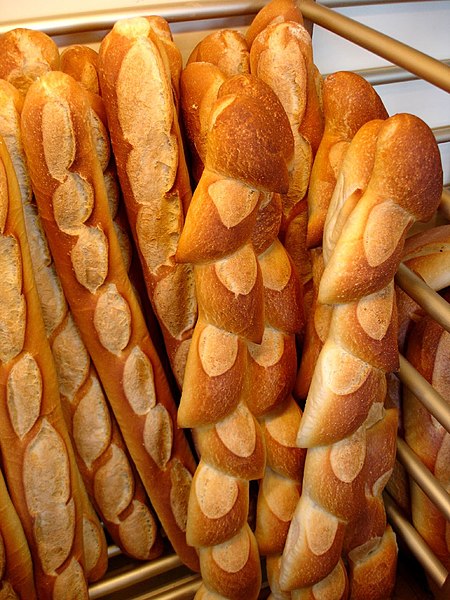
I don't personally know what I would do if I had coeliac disease myself. I would struggle to abstain from all those foods with gluten in them that make French cuisine so sophisticated. Granted, not all French recipes have gluten in them: - tartiflette and cassoulet are two examples I have discussed in previous blog posts that don't normally contain gluten. However, I would struggle to do without my morning baguette: - a micro baguette of course. One can buy large French sticks like the ones in the photo above. However, as Mireille Guiliano agrees, the optimum size of a portion of bread for a sophisticated Frenchwoman such as myself is about the size of an old cassette tape. Gosh, I feel so old, given that I can remember these! Still, as Zoë Williams correctly points out (grudingly and somewhat sarcastically), we Frenchwomen excel in all of life's seasons, whether it be the young filly season or the old bag season, tee hee.

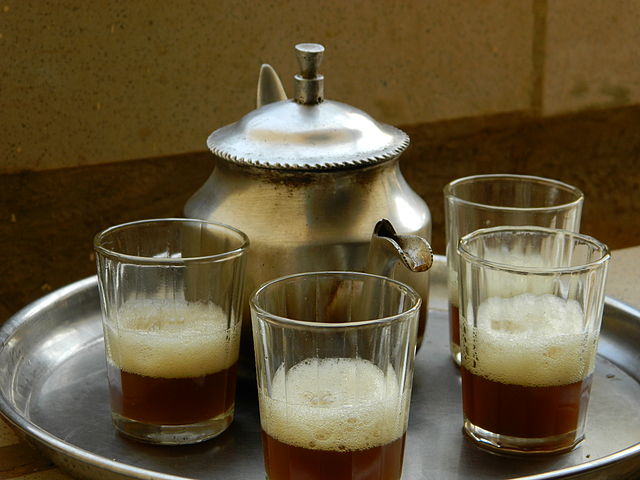
Anyway, enough about that silly woman! Bilal has introduced me to various aspects of Malian cuisine and some of it, though nowhere near as sophisticated as French cuisine, at least appears to be vaguely edible. I am particularly curious about the way tea is drunk. Normally, what happens is they pour the tea from a great height into the pot several times over. Supposedly, this enhances the flavour, but even my sophisticated French palate can't tell the difference, so I have no doubt that this is made up. It isn't as sophisticated as Mariage Frères tea, but it is just about bearable. Still, if I get married to Bilal, I will have to make some adjustments: - it won't do for him to be in bed alongside me and having bowel problems! MDR!

So there you have it: - coeliac disease is definitely not a yuppie disease (along the lines of man flu), as I indicated in a previous blog posting about gluten intolerances, tee hee! Bilal is about as un-yuppieish (yes, I acknowledge there is no such word) as you can imagine. Granted, some Anglo-Saxon yuppies like to spend ages reading medical textbooks and therefore induce symptoms psychosomatically, but occasionally, there are genuine cases of food issues and Bilal is one such example. All you yuppies out there, stop pretending you have diseases you don't really have! It makes a mockery of the people who really do have them!

.jpg/640px-Taguella_001_(s@lim).jpg)





.jpg/320px-Bouillabaisse_(4254761968).jpg)


