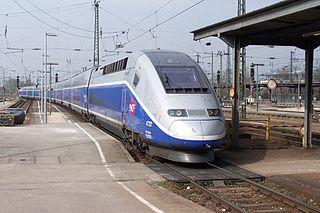
Welcome to Impossibly Dainty French Woman, the The #1 blog dedicated to explaining to women worldwide how to be impossibly perfect like we Frenchwomen and enjoy the French lifestyle, be it the trains or beautiful cities, but most of all the cuisine that facilitates us in our quest to remain pencil-thin. Please subscribe to this blog to receive updates by e-mail (below).
As I have been keen to point out, we French are the best at pretty much everything, except perhaps low taxes and sumo wrestling, being fat ladies in circuses and gastric bypass operations (given the low amount of practice our doctors get in such matters, MDR). Some things we are better at than others. However, one thing we are notorious for being the best at is railway systems.
To make it clear that I am not misleading people on this point, I am not for one moment suggesting that we French were the first country in the world to have a high-speed network: - that title belongs to Japan (a country also characterised by very thin women, tee hee). We were not even the first European nation to have a high-speed line: - that title belongs to the Italians, who inaugurate the Direttissima in 1977 (though they were bonkers enough to electrify the line at 3kV DC). We are, unfortunately, never likely to be the European nation with the longest high-speed network in Europe (thanks to our incompetent pinko-liberal commie socialist president cutting back on high-speed line construction): - this title belongs to Spain, which is planning to open a large number of new routes next year.
However, in spite of not holding such records (though we do hold the record for the fastest speed achieved on a conventional line), we are nevertheless the best at high-speed rail networks. It is not really about one single factor. Rather, it is the combination of low prices, good journey times, comfort, extensiveness of destinations covered, airport connections and many other factors.
One of the great things to come out of France's railway industry is the AGV, which stands for "Automotrice à Grande Vitesse", which roughly translates as "Self-Propelled Vehicle at High-speed".
The reason for this name being used is that this is the first super high-speed train to be produced by Alstom that truly uses the EMU (electric multiple unit) configuration. The trains produced for Eurostar are technically classed as EMUs, given that there is some traction equipment in the front and rear passenger carriages. This is probably necessary, given the long length of the rolling stock and the small space for equipment on account of the small loading gauge: - the British are so daft when it comes to railway construction that they use loading gauges almost as small as a Frenchwoman's waistline! Tee hee! Anyway, up until recently, high-speed rolling stock produced by Alstom has used the locomotive configuration. This is not to say that this is the first time such technology has been used on high-speed rolling stock: - the Japanese have used EMU configurations with the Shinkansen since they first entered service in 1964.
Another point that is fairly distinctive about France's high-speed rolling stock is its articulated nature. Granted, France is not the only country to use high-speed articulated rolling stock. Talgo (a Spanish rolling stock manufacturer) in particular uses articulated rolling stock: - Bilal and I travelled on such a train on the day we travelled to Seville. That is before I mention that France's Alstom supplied Spain's first high-speed rolling stock for the opening of the Madrid-Seville line in 1992! MDR! This rolling stock is articulated and mostly identical in design to a French single-decker TGV, though with a few distinctions, including the white exterior and beefed-up air conditioning: - it is reasonably common for Córdoba and Seville (two cities along the route) to have temperatures exceeding 40 degrees in summer. South Korea also uses Alstom-derived articulated rolling stock.
As far as I am aware, one of the reasons SNCF has not yet decided to purchase any AGV sets is the fact that more motors means more maintenance. I cannot confess to having seen the numbers put together, but certainly, low costs are good, as they help reduce reliance on cars and help make the railways a mass-market solution. Walking to the station is one of the ways in which we impossibly dainty and perfect Frenchwomen build passive exercise into our routines and I must admit, it would be a bit of a hassle to park our cars slightly further away from home, so as to build passive exercise into our routines. I am therefore glad that we have such a great railway network. However, there are some routes where I think AGVs could be particularly useful. For instance, they would be very useful once the LGV Est extension to Strasbourg and the LGV Sud Europe between Tours and Bordeaux have been completed, given that the current route has several stops and most of the new route will have alignments suitable for 350km/h running. With fast services such as these, there will be more of an incentive for people to use Marne La Vallée-Chessy and Massy TGV stations, particularly given that Massy TGV will be along the future Line 18 that comprises part of the Grand Paris Express project.
Though I am a little disappointed by François Hollande's government's decision to slow down high-speed line construction, I still think we French are the best in the world when it comes to high-speed rail systems. I love the fact that I can be in the cold Northern European climate of Lille and then 4h50m later be back in sunny Marseille. I will also love the fact that once the link to Bordeaux is completed, I might find myself explaining to some Anglo-Saxon business contacts about how sophisticated French wines are, spontaneously hop on a train to Bordeaux, be there in just over two hours, savour the fine wines and easily get back to Paris that day if we wish. I will also love being able to show people the proper way to do a Kouglof (not overly sweet), as well as the beautiful mixed architectural styles of Strasbourg after a train ride of just 1h50m when the second phase of the LGV Est opens. In short, we French are the best at pretty much everything.
One thing I have been ranting about a lot recently (in spite of Zoë Williams' bitchy comment about how French women light up another fag and say "bof" in preference to ranting) is François Hollande's government's recent decision to almost indefinitely delay several LGVs (Lignes à Grandes Vitesses, or high-speed lines) and renew the rolling stock on the conventional network. My main point of contention is that he has messed up the economy and therefore virtually cancelled them, using the new regional rolling stock (for the acquisition for which SNCF concluded the financial agreement on the 26th of September) as a smokescreen for his own incompetence.
Anyway, given this piece of train news, I thought I would take this opportunity to brag about how impossibly perfect Alstom (our main national trainbuilder) is when it comes to rolling stock, focusing on their past, present and future high-speed rolling stock. As I have often said, there is nothing ladylike about being a gricer, but Alstom's high-speed rolling stock is part of what makes we French effortlessly perfect.
Alstom's first high-speed train in normal service in France was the TGV Sud-Est that commenced operations in 1981.
This was in the benighted days (unfortunately, virtually every other nation in the world is still benighted in this respect) when the full extent of France's high-speed track was the first phase of the LGV Est, which back then just covered part of the route between Paris and Lyon. My mother moved to Marseille in 1980. Just as is the case today, Marseille's fashion scene was not as extensive as that of Paris. My mother always loved the sight of France's countryside, so she always preferred taking the train. Before the first phase of the LGV opened, the journey was around 10 hours, I think I recall my mother saying. As the years went by, journey times gradually eroded.
The first phase of the LGV Est (between Saint-Florentin and Sathonay) entered service in 1981. The second phase between Combs-la-Ville and Saint-Florentin entered service in 1983. In 1992, the first phase of the LGV Rhône-Alpes entered service (between Montanay and Saint-Quentin-Fallavier), with the second phase (between Saint-Quentin-Fallavier and Saint-Marcel-lès-Valence) entering service in 1994 (at the same time as Lyon-Saint-Exupéry TGV station entering service). The final push to Marseille with the LGV Méditerranée (between Saint-Marcel-lès-Valence and the outskirts of Marseille) began in 1996 and this final section entered service in 2001.
The entry into service of the final section enabled journey times of 3h05m between the ritzy-glitzy fashion scene of Paris and the beautiful sunny weather, soap, olive oil, Herbes de Provence, Vieux Port, pine trees on the hill on which the basilica of Notre-Dame de la Garde is sitauted, pastis etc of Marseille. Abba felt strongly enough about Parisian summers to write the song "Our last summer", whose lyrics are as follows: -
The summer air was soft and warm
The feeling right, the Paris night
Did its best to please us
And strolling down the Elysée
We had a drink in each café
And you
You talked of politics, philosophy and I
Smiled like Mona Lisa
We had our chance
It was a fine and true romance
I can still recall our last summer
I still see it all
Walks along the Seine, laughing in the rain
Our last summer
Memories that remain
We made our way along the river
And we sat down in the grass
By the Eiffel tower
I was so happy we had met
It was the age of no regret
Oh yes
Those crazy years, that was the time
Of the flower-power
But underneath we had a fear of flying
Of getting old, a fear of slowly dying
We took the chance
Like we were dancing our last dance
I can still recall our last summer
I still see it all
In the tourist jam, round the Notre Dame
Our last summer
Walking hand in hand
Paris restaurants
Our last summer
Morning croissants
Living for the day, worries far away
Our last summer
We could laugh and play
And now you're working in a bank
The family man, the football fan
And your name is Harry
How dull it seems
Yet you're the hero of my dreams
I can still recall our last summer
I still see it all
Walks along the Seine, laughing in the rain
Our last summer
Memories that remain
I can still recall our last summer
I still see it all
In the tourist jam, round the notre dame
Our last summer
Walking hand in hand
Paris restaurants
Our last summer
Morning croissants
Living for the day, worries far away
*Fade*
Paris summers are wonderful, but Marseille summers are even better. When I was living in Paris and a summer's day was lacklustre (which happens from time to time), I loved hopping on a train to Marseille, walking over to the hill on which the basilica of Notre-Dame de la Garde is situated, admiring the views from the top and walking a short way down the hill and breathing in the scent of pine in hot weather. A Frenchwoman loves the simple pleasures in life, even if she does strive to keep her eye on the ball when it comes to the latest fashions, MDR.
Anyway, back to the trains. After the TGV Sud-Est, there was the TGV Atlantique, which achieved the world speed record in 1990 and was built originally for the LGV Atlantique that currently runs as far as Tours and Le Mans via two different branches.
After that was the TGV Réseau, which I believe was the first of France's high-speed rolling stock models to be capable of 320km/h in service. These entered service in 1992.
The TMST, or Eurostars, entered service along with the Channel Tunnel in 1994. The British decided to dither about building the Channel Tunnel Rail Link, so these trains had to be built to the British loading gauge (which is almost as small as a Frenchwoman's dainty figure, tee hee) and it also had to be made compatible with the British third rail system (a totally stupid system for intercity trains and only really stupid people like the British would ever use it, MDR). Fortunately, now the Channel Tunnel Rail Link is complete, Eurostar has placed an order with Siemens for UIC gauge trains without third rail compatibility, which makes things much simpler, but the downside is that Eurostar rejected Alstom's bid in favour of Siemens' bid, which the French government was rightly unhappy about, given that we French are the best at everything, including trainbuilding.
These sets were also ordered in shorter variants known as the "North of London" sets. Unfortunately, the British did some market research, found there wasn't much demand for these services and, rather than doing the sensible thing of trying to grow the market, just gave up and SNCF eventually acquired these "North of London" sets for domestic use. Shame they are built to the British loading gauge standards and French customers are therefore uncomfortable in them, but that is better than them going to waste because the stupid British couldn't be bothered to make more effort to promote high-speed rail travel.
Next was the TGV Duplex, the first double-deck high-speed rolling stock used by SNCF, built for economies of scale and capable of running in service at 320km/h. The power-weight ratio is a huge improvement over the TGV Sud-Est (being effortlessly perfect also involves fast advances if you see what I mean).
Then there were the Thalys PBKA (which stands for Paris, Brussels, Köln or Cologne and Amsterdam). The original PBA sets were constructed using TGV Réseau sets. The PBKA variant has 15kV 16.7Hz capability, though because it is a fairly rubbish design (unusually for things in effortlessly fabulous France), it is limited to 200km/h running under this traction supply voltage and frequency. It regrettably also cannot run on the Cologne-Frankfurt new line, with its 4% gradients. We shall see if Thalys decides to buy some new rolling stock in light of the new route to Lille, Deutsche Bahn pulling out the arrangement and the disastrous Fyra contract with AnsaldoBreda (and the consequent need to run the journeys with other rolling stock): - any French woman could have told the stupid Belgians and Dutch to just buy from France, where everything is effortlessly fabulous! My advice to Thalys is that it procures new rolling stock, buys it from Alstom and specifies in the tender from the beginning that it is to have full compatibility with 4% gradients, 15kV 16.7Hz electrification, 320km/h running under all the main four electrification systems etc.
Next is the TGV POS (Paris-Ostfrankreich-Süddeutschland, or Paris-Eastern France-Southern Germany). The most notable point about this rolling stock model is that a modified version of this achieved the world speed record of 574.8km/h on the then-unopened LGV Est.
The other noteworthy model is the TGV 2N2, the successor to the similar Dasye sets, which was designed with international operation in mind. I believe the first variant entered service in 2011 and I am under the impression that there are different variants according to routes. The variant compatible with 3kV electrification will be used for journeys to Spain (at the time of writing, TGVs only went as far as Figueres-Vilafant station, where it was necessary to change for other trains to continue into Spain).
That is pretty much the bulk of high-speed rolling stock models by Alstom that operate in France. Also noteworthy is the AGV (Automotrice à Grande Vitesse), an EMU (electric multiple unit) high-speed train used by the private operator NTV in Italy. Alstom proposed this with the Eurostar tender a few years ago, but this was rejected in favour of the Siemens Velaro platform. Alstom has also been involved in high-speed trainbuilding for countries such as South Korea and Spain.
There are various proposals that have existed at one time or another. For instance, Wikipedia's AGV article has talked about a 400km/h locomotive setup. Also, Alstom proposed a Speedelia with the Trenitalia tender a few years ago: - I think the fact that the Italians gave the contract to a consortium of AnsaldoBreda and Bombardier shows that Italians wouldn't know quality if it bit them on the backside. Anyway, enough detail for one article. This brief history of Alstom's high-speed rolling stock shows that it is not just dainty portions of top-quality food that we French are fabulous at, but also the manufacture of high-speed trains. Vive la France!


.jpg/320px-Italo_NVT_Class_575_No_575-154_(8614798976).jpg)