Welcome to Impossibly Dainty French Woman, the The #1 blog dedicated to explaining to women worldwide how to be impossibly perfect like we Frenchwomen and enjoy the French lifestyle, be it the trains or beautiful cities, but most of all the cuisine that facilitates us in our quest to remain pencil-thin. Please subscribe to this blog to receive updates by e-mail (below).
As I have been keen to point out, we French are the best at pretty much everything, except perhaps low taxes and sumo wrestling, being fat ladies in circuses and gastric bypass operations (given the low amount of practice our doctors get in such matters, MDR). Some things we are better at than others. However, one thing we are notorious for being the best at is railway systems.
To make it clear that I am not misleading people on this point, I am not for one moment suggesting that we French were the first country in the world to have a high-speed network: - that title belongs to Japan (a country also characterised by very thin women, tee hee). We were not even the first European nation to have a high-speed line: - that title belongs to the Italians, who inaugurate the Direttissima in 1977 (though they were bonkers enough to electrify the line at 3kV DC). We are, unfortunately, never likely to be the European nation with the longest high-speed network in Europe (thanks to our incompetent pinko-liberal commie socialist president cutting back on high-speed line construction): - this title belongs to Spain, which is planning to open a large number of new routes next year.
However, in spite of not holding such records (though we do hold the record for the fastest speed achieved on a conventional line), we are nevertheless the best at high-speed rail networks. It is not really about one single factor. Rather, it is the combination of low prices, good journey times, comfort, extensiveness of destinations covered, airport connections and many other factors.
One of the great things to come out of France's railway industry is the AGV, which stands for "Automotrice à Grande Vitesse", which roughly translates as "Self-Propelled Vehicle at High-speed".
The reason for this name being used is that this is the first super high-speed train to be produced by Alstom that truly uses the EMU (electric multiple unit) configuration. The trains produced for Eurostar are technically classed as EMUs, given that there is some traction equipment in the front and rear passenger carriages. This is probably necessary, given the long length of the rolling stock and the small space for equipment on account of the small loading gauge: - the British are so daft when it comes to railway construction that they use loading gauges almost as small as a Frenchwoman's waistline! Tee hee! Anyway, up until recently, high-speed rolling stock produced by Alstom has used the locomotive configuration. This is not to say that this is the first time such technology has been used on high-speed rolling stock: - the Japanese have used EMU configurations with the Shinkansen since they first entered service in 1964.
Another point that is fairly distinctive about France's high-speed rolling stock is its articulated nature. Granted, France is not the only country to use high-speed articulated rolling stock. Talgo (a Spanish rolling stock manufacturer) in particular uses articulated rolling stock: - Bilal and I travelled on such a train on the day we travelled to Seville. That is before I mention that France's Alstom supplied Spain's first high-speed rolling stock for the opening of the Madrid-Seville line in 1992! MDR! This rolling stock is articulated and mostly identical in design to a French single-decker TGV, though with a few distinctions, including the white exterior and beefed-up air conditioning: - it is reasonably common for Córdoba and Seville (two cities along the route) to have temperatures exceeding 40 degrees in summer. South Korea also uses Alstom-derived articulated rolling stock.
As far as I am aware, one of the reasons SNCF has not yet decided to purchase any AGV sets is the fact that more motors means more maintenance. I cannot confess to having seen the numbers put together, but certainly, low costs are good, as they help reduce reliance on cars and help make the railways a mass-market solution. Walking to the station is one of the ways in which we impossibly dainty and perfect Frenchwomen build passive exercise into our routines and I must admit, it would be a bit of a hassle to park our cars slightly further away from home, so as to build passive exercise into our routines. I am therefore glad that we have such a great railway network. However, there are some routes where I think AGVs could be particularly useful. For instance, they would be very useful once the LGV Est extension to Strasbourg and the LGV Sud Europe between Tours and Bordeaux have been completed, given that the current route has several stops and most of the new route will have alignments suitable for 350km/h running. With fast services such as these, there will be more of an incentive for people to use Marne La Vallée-Chessy and Massy TGV stations, particularly given that Massy TGV will be along the future Line 18 that comprises part of the Grand Paris Express project.
Though I am a little disappointed by François Hollande's government's decision to slow down high-speed line construction, I still think we French are the best in the world when it comes to high-speed rail systems. I love the fact that I can be in the cold Northern European climate of Lille and then 4h50m later be back in sunny Marseille. I will also love the fact that once the link to Bordeaux is completed, I might find myself explaining to some Anglo-Saxon business contacts about how sophisticated French wines are, spontaneously hop on a train to Bordeaux, be there in just over two hours, savour the fine wines and easily get back to Paris that day if we wish. I will also love being able to show people the proper way to do a Kouglof (not overly sweet), as well as the beautiful mixed architectural styles of Strasbourg after a train ride of just 1h50m when the second phase of the LGV Est opens. In short, we French are the best at pretty much everything.
Over the summer, my magazine had a very quiet time, due to the lack of fashion-related announcements (things will pick up, now that autumn is arriving). As a result, I decided to take an additional holiday for a few days. My destination of choice was Strasbourg. I have a few friends living in Strasbourg who I wanted to catch up with.
I decided to go there by train, as I wanted to see the new LGV Rhine-Rhône high-speed railway line: - most of my rail travel is spent travelling between Marseille and Paris and occasionally London (unfortunately). I hadn't yet experienced the relatively new LGV Rhine-Rhône high-speed line.
Like the LGV Est that runs between Paris and Baudrecourt (going approximately 2/3 of the way to Strasbourg), the operating speed is 320km/h: - as impossibly perfect as we French are, we haven't yet found an engineering solution to the problem of the track ballast disintegrating at speeds and the generally enormous maintenance outlay if one runs trains in service at speeds above 320km/h. It is possible to run trains at 320km/h on conventional rails, but so far, Japan (an almost perfect country, but still not up there with France) is the only other nation where this is done at the time of writing.
The journey there took quite a while (6h08m to be precise), given that not all of the Marseille-Strasbourg route is high speed and there were a large number of intermediate stops (Avignon TGV, Valence TGV, Lyon Part Dieu, Bourg-en-Bresse, Lons-Le-Saunier, Besançon-Viotte, Belfort-Montbéliard TGV, Mulhouse Ville and Colmar). I wasn't in a hurry though, as a Frenchwoman likes to slowly unwind and savour her holidays: - American acquaintances tell me that people often don't take all their annual leave because they fear people usurping their jobs if they spend more than a week away. Such an idea is alien to a Frenchwoman, being effortlessly fabulous at her job.
I recall seeing a few noteworthy new sights along the route, such as the Savoureuse viaduct that the train travelled across, which I believe is near Belfort-Montbéliard station.
After the long and relaxing journey, I also enjoyed the sight of Strasbourg's central station, with its glass exterior combining with the older structure to make a very nice hybrid of old and new.
As mentioned in a previous posting, I enjoy the taste of Kouglof, a local delicacy. As I keep saying, bumpkins like desserts to be as sweet as possible, whereas stylish people like desserts to be only as sweet as they need to be to cleanse the palate of the previous course. Kouglof is one such dessert that accomplishes this. I have seen American and British business colleagues bite into it and their faces screw up, as they were expecting something disgustingly sweet and they find the taste almost savoury. Well, I could have told them that it was a brioche rather than a cake in advance, but I enjoy such opportunities to gloat about how sophisticated I am for not liking the taste of overly sweet desserts! MDR.
The city has history in buckets. Some people au fait with this subject may be aware that John Calvin (who was born in Noyon in Picardie) preached at four different churches in the city.
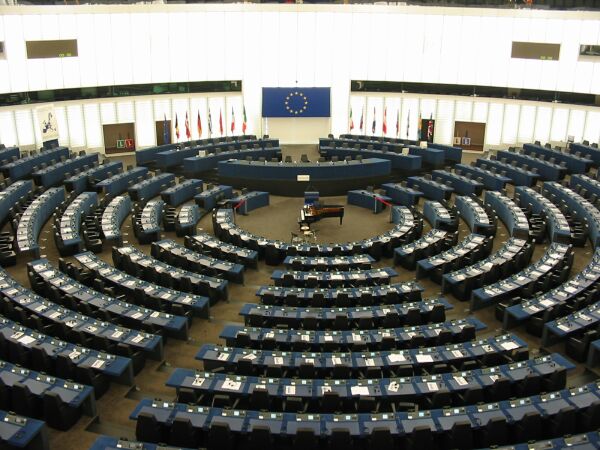
It is also the home of the European Parliament building.
I don't follow politics much (except when they are talking about raising or lowering taxes), but I gather the European parliament has some MEPs who are some very funny jokers, including Nigel Farage, who comes from the unsophisticated nation that is my mother's homeland. Below is a video of his famous "BBBBBBBBBBAFFLING!!!!!!!!!!!!!!!!!!!!!!!!!!!!!!!!!!!!!!!!!!!!!!!!!!!!!" speech after he was informed that the EU was the winner of the Nobel Peace Prize.
Strasbourg is also home to the European Court of Human Rights. I wonder if I might be able to take any cases there that concern the enormously high rates of tax we have to pay in France? I heard an American tried going to some constitutional court to challenge the government's right to impose income tax. Maybe we French should take a similar case to the European Court of Human Rights?
A Frenchwoman likes to walk everywhere and I found out that the German city of Kehl was on the other side of the Rhine and a short walk away.
Germany is a far less sophisticated nation than France and there are loads of fatties that appear to drink a gallon of lager every evening. However, it is sometimes necessary to go abroad to appreciate one's own country. In any case, Kehl is a fairly pretty city, with its tower (the Weißtannenturm) that one can walk up (a Frenchwoman likes walking up stairs and hates taking the lift) and get a good view of the scenery for miles around from.
All in all, I had a very lovely holiday. The weather wasn't as warm as Marseille, there weren't swathes of lavender fields nearby, there weren't people sipping pastis everywhere and it generally wasn't as fabulous as Marseille generally, but it is lovely to go to different places and see different things sometimes. I wouldn't appreciate Marseille so much if there weren't this diversity of other French cities to see.
If any Brits are reading this, it is easy to reach Strasbourg by train (Eurostar, changing at Lille or Paris) and it will be even easier once the second phase of the LGV Est is complete (it will then be 1h50m from Paris). It will gradually feel closer and closer to Marseille as the other parts of the LGV Rhine-Rhône are completed (it is anyone's guess when this will happen, given that François Hollande has delayed several lines on account of having messed up the economy).
All in all, I had a lovely time, but it was such a great feeling getting back to Marseille. The train enters the Tunnel de Marseille shortly after Aix-en-Provence and it is lovely to come out of that tunnel and be greeted with the sight of Marseille again. As the old saying goes, there's no place like home.


.jpg/320px-Italo_NVT_Class_575_No_575-154_(8614798976).jpg)




_in_Kehl_02.jpg)


