2017-01-13

When will the boys become (gentle)men?

From the very beginning, Bilal has been open about his desire for a large family with me.  He told me that whilst he would never force himself upon me, he will push me to agree to more children as long as the opportunity is available.  I was slightly taken aback by his honesty, but I quickly remembered that I have lots of female acquaintances who have married men who turn out not to want children (particularly if they are older and have previous marriages behind them), or they have lost their enthusiasm for more children after the arrival of the second or so.  I mentioned this to sisters-in-Christ and they expressed the view that such a desire definitely increases a man's desirability to them.  A few weeks after our son was born, Bilal raised this issue with me and said he wanted to try for our second child with no delay.  Even with our second child not yet born, he is already talking about trying for our third one.


Bilal comes from a society where life expectancy is extremely low.  According to the World Health Organisation's 2015 statistics, France's life expectancy was 82.4 years, whereas in Mali it was 58.2 years (near the bottom of the table).  The situation for the Touareg people is even worse, with Minorityrights.org saying that their life expectancy in 2013 was 48 years.  From all I have lead to believe, this situation results in the Touareg people taking the view that time is always limited for doing things in life, in particular childbearing.  There is no time for men to do things like long, extended university studies, followed by time travelling, followed by time spent drifting in one's career and finding one's feet many years later, before finally getting married in one's fourties and grudgingly having children as one's fifties approach.  Touareg men have the mentality that they won't be around long, so they have to work hard to save up to get married, get married as soon as possible and then have as many children as they possibly can in as short a period as possible.  They will typically learn to start keeping livestock at the age of three or four.  I quite like this mentality, as it means men grow up very quickly: - no Peter Pan characters there!  Death isn't a taboo theme with Bilal, as he has maintained his Touareg mentality of life being short: - he also received regular reminders when he witnessed gang shootings in La Savine.


Putting aside the issue of religion, I would seriously advise women frustrated with men who are indifferent about their female biological clocks to seriously think about a Touareg husband!  Bilal is not afraid of getting his hands dirty, putting himself in danger for others, working hard in very arduous conditions or anything like that!  I remember when we were out walking in Marseille one summer evening and he was walking a few metres behind me.  I passed some guys in their mid-30s dressed like teenagers who had set up their X-Box One on the street for some al fresco playing and were puffing away on joints.  One of them said, "That chick is hot!  I want one like that one day!"  They didn't realise Bilal is my husband and he turned round and said to them, "Man agrees: - manz wifey is well buff, innit?  Dat's why man pursued her all the way up da aisle.  Maybe you'll get one too if you do something besides playing computer games, be a man, make something of yourself and go after one?"  One of them then said, "What?  You think you're a bigger man or something?"  Bilal replied, "Yeah.  I knocked her up straight away after marrying her and then again only a few weeks after our son was born."  I was trying hard not to laugh when I heard Bilal say that. When he caught up with me, I told him it wasn't appropriate to accuse some he didn't know of being immature based on little evidence, to which Bilal said he knew them well.  Bilal has never really cared about being a gentleman and I am aware many feminists wouldn't like to be spoken about in that way, but I do because I love real men!  MDR.


In some ways, Bilal is quite feminine.  He spends more time with our son than I do, as his job has regular hours and doesn't require him to travel: - dealing with a screaming baby when at the front row of a fashion show is not easy, MDR.  Our childcare arrangements mean he could spend the evenings socialising with his "homies" if he wanted, but he has chosen not to do that: - he has told his "homies" very bluntly that he is happy to socialise with them, but they have to either visit him at home or they have to go somewhere baby-friendly.  He also found his gym wasn't very amenable to men bringing in small babies, as it wasn't the type of image they were trying to create.  He threatened to take his custom elsewhere (and with him all the women who come along to gawp at him and men who come for his advice) and they soon backed down.  A few men unfamiliar with him initially poked fun at him for bringing our son along, but that was before seeing his body in the changing rooms, MDR.


Large families used to be common in times gone by in France, though I am doubtful many French men were as open as Bilal about how conception was a boost to their egos, MDR!  The Church of Rome has had a consistent policy of opposing contraception, though its power in France has been severely curtailed ("laïcité"), particularly with the 1905 law separating church and state, long before contraceptive methods became available.  I think it is good that the Church of Rome's influence has been restricted in France, but it is a shame that a consequence of this has been people's unwillingness to have children.  Much is made of France's high fertility rate, but the reality is that it tends to be the immigrants having children.  French men don't know how to be men any more!  With the great figures we Frenchwomen have and the female-biased gender ratio, few men can justifiably claim the absence of options, particularly if they lived in nearby Vitrolles in the late 1990s.  Bilal is aware of the baby bonus that Catherine Mégret briefly introduced for children born to at least one French/EU parent.  I remember someone asking him about her, assuming that he would dislike her on account of her supposedly "xenophobic" policies.  Bilal replied, "Fam, she used to be quite fit, though not as fit as manz wifey".  MDR!


Much is made of French men being seductive, but in my view, they have become wussies over the past few decades.  Prior to my relationship with Bilal, I was often approached by men, who I am sure never bothered to call my father when I gave them his business card.  Giving them my father's business card was never intended to put them off per se, it was intended as a test of their manhood!  I love the way Bilal talks to his "homies" about his marriage to "a well buff wifey" like me as being a conquest.  He first asked for permission to court me aged 18 (he was starting university, but already had a large income from his share-trading activities), which my father declined.  Bilal made several more attempts over the next few years while I was at university and subsequently working in the fashion industry before he finally conquered my father and subsequently me.  Bilal's ignorance about how to speak about women in a gentlemanly fashion didn't help, but Daddy later came to realise that he is a man with some rough edges when his activities at church became more apparent.  Daddy tried to turn him into a gentleman during our courtship and engagement without success.


French life expectancy has increased dramatically during the past few centuries, even the past few decades and doesn't appear to be slowing down.  People had more children in times gone by because of the low expectation that they would reach adulthood, i.e. having lots in the expectation of getting lucky with a few.  As mentioned, this is part of Bilal's subconscious mentality.  It is likely that many people have no rush to get married and have children because they think they have all the time in the world.  They prolong adolescence.  It is not such a problem for men when they do this in France, given the gender ratio and the fact that they are surrounded by fabulous women, but the numbers are not really in women's favour, as discussed extensively in an article entitled "The case for settling for Mr. Good Enough".  Also, given the expectation that the man will initiate, courtships tend to be according to the man's timing.


I am hoping that our son will grow up to have my French finesse and Bilal's ruggedness.  Bilal has said he intends to take him on regular holidays to Mali to develop them as herdsmen (I didn't argue, as I support this fully, even though I know many French mothers wouldn't).  Bilal finally managed to find a farm suitable for livestock somewhere near Marseille, so that our son (and future children) will be able to practice even when he isn't in Mali.  Bilal is also learning about mountaineering so that he can teach our son to operate in such environments in the absence of deserts here in France.  This won't be possible full-time, as he will need to be diligent in his academic studies, but the aim is that he will be well-prepared for both lifestyles.

On the other hand, I have insisted that I and my male relatives teach him how to be a gentleman and to speak proper French.  Obviously, it is still quite early to think about our son's career, but I was thinking a commission in the French foreign legion might be a profession where both these qualities are required.  They are based in Aubagne, which is more or less on our doorstep in Marseille.


I came across an article about Memminger High School in Charleston, South Carolina, which has a "Gentleman's Club" (in my view, a very unfortunate double entendre), which teaches young inner-city boys to be gentlemen.  To me, given Charleston's position as the epitome of Deep South gentility, it seems a shame that the boys didn't pick such things up.


A quick Google search also revealed the London School of Etiquette, which does this, but in a paid formal setting.  I am not enthusiastic about sending our son to a boarding school where he would learn this, as I believe that raising children is the parents' job, but I would be delighted if our son grew up to have all the airs and graces of both suave Frenchmen and stereotypical English gentlemen in addition to Touareg ruggedness.  Nobody can say if he will grow up to be sufficiently well-suited to the military lifestyle, but I could just imagine him in a Foreign Legion officer uniform (their headquarters is in nearby Aubagne).


I am not talking Bilal down, as I recognise that he has the personality traits that really matter: - finesse is not one of them.  However, it would be a shame if our son were held back in life or weren't able to woo the woman of his dreams because Bilal passed on his ignorance of gentlemanly conduct.  Certainly, there is an abundance of French men who have a reasonable amount of finesse, but there is a deficit of French men who know how to be real men, rugged and pursue a woman properly.

2017-01-04

Christmas in France

I recently read a BBC News Online article about Christmas in France which paid particular attention to French Christmas cuisine: - rightly so, as it is far superior to what is available in the Anglo-Saxon world.  As mentioned in a previous blog post, Provence has some unique Christmas traditions of its own.  With the advent season drawing to a close, I will explain them (also with a focus on the culinary aspects), explaining where things are different in our family because we subscribe to reformed Christianity (rather than the false doctrines of the Church of Rome): - the 1689 confession, available in English and French, amongst other languages, is one of the few good things to come out the UK.


Some reformed Christians in France are too indifferent to celebrate Christmas, given the lack of a biblical obligation to do so.  There is nothing wrong with this, as clarified by Romans 14:5.  Me personally, I think Christmas has been a great thing, given its success in supplanting the pagan feast of Mithras: - it has been so successful that few people even know what that was about today.  In any case, as reformed Christians, there are very few special days in the calendar.


Bilal has no Christmas traditions of his own, as he is a Muslim convert.  Upon his conversion to Christianity, he refused to celebrate Eid-al-Adha and Eid-al-Fitr (two Islamic festivals), which naturally caused friction, but I think his family is thankfully now resigned to the fact that he is not going to regress to Islam.


Traditionally, Provence has Le Gros Souper ("Lou Gros Soupa" in the local dialect), eaten before Midnight Mass (an Anglo-Catholic Tradition that we don't practice).  Le Réveillon is traditionally started after midnight on the night of the 24th/25th of December following Midnight Mass.  Whilst we don't have Midnight Mass, Le Gros Souper and Réveillon mirror the traditional timings with us.  Historically Church of Rome nations tend to finish their celebrations after that, with historically protestant nations (particularly Anglo-Saxon ones) having more on the 25th.  As a result, we tend to have a Christmas Day service instead of a Midnight Mass, so we plan our overnight stays so as not to be too tired for church the next morning (Christmas Day was on a Sunday this year).  This year's Réveillon and Déjeuner de Noël (Christmas Lunch) were relatively short, given the church activities on the Sunday.


Santa Claus is known as Père Noël ("Père" = "Father" and "Noël" = "Christmas") in France and children leave shoes, rather than stockings, for him.  As far as I know, nobody in our church bothers with this: - we tell our children early on what we want them to believe and what we don't, as there is enough confusion in our atheistic societies about what we should believe.  We want them to believe in God the Father, Son and Holy Spirit, so we tell our children about them, but we tell our children as early as possible that Santa Claus/Père Noël is based on Nicholas of Myra (Turkey), who was a bishop (in the incorrect Church of Rome/so-called Orthodox understanding of the word) many centuries ago and not alive today.


I said I would write about culinary tradition and haven't said much so far, so I will start.


Christmas meals in France tend to observe standard customs for apéritifs and digestifs, the former supposedly being to stimulate the appetite (admittedly not always desirable for a dainty Frenchwoman such as myself) and the latter to aid digestion.  As far as I know, there is no scientific basis for either, but that misses the point: - we French have a very sophisticated consumption of alcoholic beverages.  Obviously, champagne featured heavily: - though I long for the day when Provence produces alcoholic beverages as world-renowned as those of the historical Champagne region, like any Frenchwoman, I just adore champagne.  I just remembered that I am overdue a visit to Reims: - I am tired of hearing silly Anglo-Saxon people pronouncing it "raymz" (it is pronounced "ranz").


Canapés (known as amuse-bouches if they are free in an eating establishment) feature very heavily in French parties, particularly at Christmas, though I must admit, to a dainty Frenchwoman such as myself, they often make up a full meal!  Bilal has been into strongman training for many years and therefore tends to have a meal before a party, so that he is content to just have canapés until the meal is served, but I admit, France hasn't always been progressive regarding gluten-free cookery, so he often goes without: - poor Bilal!  I try to push people to accommodate him though, so as to expand his repertoire beyond jollof rice, MDR.  Canapés generally consist of bread, pastry or a cracker.  They tend to be salty or spicy, so as to get people to buy more drinks, but in most societies, it is the custom for savoury food to be served before sweet food anyway.  Vol-au-vents (above) are a very common canapé: - there are so many different fillings that go well with them, such as cream cheese, paté, fish paste etc.


Foie gras is a common French Christmas tradition, but it is not an acceptable food for us as Bible believers.  Granted, there are at least 10 passages in the New Testament saying all foods are acceptable to eat, but the cruelty inflicted on the ducks and geese (force-feeding so their livers become 10 times their normal size) is not something I can stomach (pun intended): - Proverbs 12:10 says that a good man is kind even to his animals.  However, we are more than happy to have paté where we have reasonable confidence in the welfare of the animals (a real Frenchwoman always looks into the provenance of her food, even if she might have a "bof" attitude towards animal welfare).  Given the coastal location of Provence, we often like fish-based patés, but they can be made with so many different fish, meat, vegetables etc.


Mireille Guiliano is absolutely correct when she talks about a Frenchwoman's preference for oysters (another Christmas food).  Given that only a small part of the physical area taken up is actually meat, they are a great way for a dainty Frenchwoman to eat less than she thinks and maintain her dainty figure.  There are various ways to season oysters, but even when eaten without seasoning, their taste is absolutely divine.  I expect to be making a few more visits to cities such as Brest to enjoy the oysters when the LGV Bretagne opens later this year: - I am hoping the timetable will be set up to allow good connections via stations such as Marne la Vallée-Chessy to avoid needing to cross Paris between Gare de Lyon and Gare Montparnasse stations.


Like the Anglo-Saxon world, turkey is very common at Christmas, though the chestnut stuffing is the main difference.  Silly British people tend to use bread-based stuffing, which is not feasible with Bilal (unless made with gluten-free bread).


Christmas logs (Bûches de Noël) are common (more so than the Anglo-Saxon world): - thankfully, most people have forgotten the pagan Yule festival that this tradition ultimately comes from, though maybe I would have reservations if it stirred up an interest in pagan culture again.  Silly British people tend to have a chocolate cream covering, but in France, people are much more sophisticated than that.  French Christmas logs have much richer flavours, including orange zest and cherry confit, plus their colours are much brighter.


Putting Provence's fantastic regional dishes to one side for one moment, various other French regions have unique Christmas dishes.  All of these dishes mentioned in the article I love, admittedly not as much as those from Provence.  They are: -

  • Capon (castrated rooster from Lauragais, between Toulouse and Carcassonne)
  • White sausages (from Rethel in Champagne-Ardenne)
  • Venison (deer meat from Sarthe, southwest of Paris)
  • Sea bass (southwestern France)
  • Stuffed goose (Alsace)
  • Lobster (Brittany)
I admit I haven't been to Toulouse very often, since it is not particularly easily accessible by train, particularly from Marseille.  However, I have managed to try capon.  Silly Anglo-Saxon people mock us when we claim we know from the taste if the rooster was castrated early in life: - I can confirm that we can tell, MDR.


Bilal came with me on a visit to Reims a while ago and was wary of the white sausages, as he was in the UK visiting his homies in Stratford and tried local sausages (silly British people stuff sausages with bread) and fell ill.  However, I checked and double-checked on his behalf that they were gluten-free, so we had them and he really liked them.


Venison is reasonably common in the UK, but the French method of preparation is far superior to the English one.  Interestingly, it was the Normans who introduced the term, MDR!  Sea bass and lobster are not unique to France either, but the preparation is far superior to anywhere else: - in France, a chef's trade is treated as a skilled craft, unlike pretty much anywhere else.


Stuffed goose (which uses apples, chestnuts and citrus fruits) is an acquired taste as far as silly Anglo-Saxon people are concerned.  In the run-up to Christmas, some English clients visited the Paris office of my magazine.  They were what are known in Britain as remoaners (a portmanteau of "remain" and "moan"), people who can't accept that the democratic will of the British people regarding Brexit, and therefore wanted to visit the European parliament whilst they were there.  They liked to act like they were cultured and aware, but didn't realise that this is in Strasbourg, not Paris!  Duh!  We therefore stepped on a train and were in Strasbourg 1h48m later (around 540km away).  They asked to try a local dish, so I found a restaurant serving stuffed goose.  They hated it because of all the sweet flavours: - silly Anglo-Saxon people struggle to understand sweet main courses.  For dessert, we had Alsatian Kouglof, which they didn't like either, as they were expecting something super-sweet, which turned out to be only a mildly-sweet brioche, MDR!


The desserts mentioned in the article are: -
  • Berawacka (Christmas fruit cake from Kayersberg, Alsace)
  • Calissons (I will cover this later)
  • Guinettes (sour cherries soaked in brandy and with a chocolate coating from Aquitane)
  • Mendiants (I will cover this later)
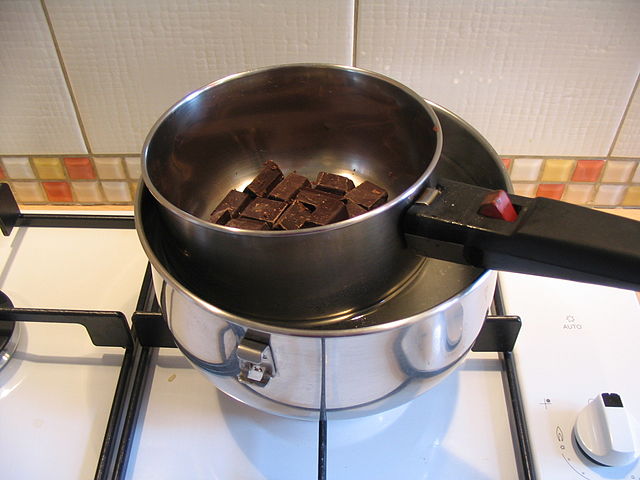
Christmas cake and pudding in the UK have some similarities with Berawacka, though they are nowhere near as sophisticated (my British visitors liked these).  Guinettes are always great for a Frenchwoman looking to make a meal with an air of sophistication for very little effort (soak the cherries, then melt the chocolate in a bain-marie before dipping the cherries inside).


Onto Provençal Christmas dishes.


As mentioned, we have Les Treize Desserts, which often feature calissons, a sweet made of ground almonds and candied fruit, topped with icing.  Aix-en-Provence is famous for producing these: - you can get there via the local TGV station, but if arriving from the Paris direction, it is easier to go to Marseille and catch a TER (34 minutes) to the town centre station, particularly as some trains don't stop at Aix-en-Provence TGV.


I am not so fond of the superstition that traditionally existed with Les Treize Desserts (representing Christ and the 12 apostles), e.g. breaking the fougasse bread (1/13), rather than cutting it, so as to avoid being indebted.  Some people regard such an act of memory as being an act of religious devotion, but we regard such superstition as being badly unbiblical.


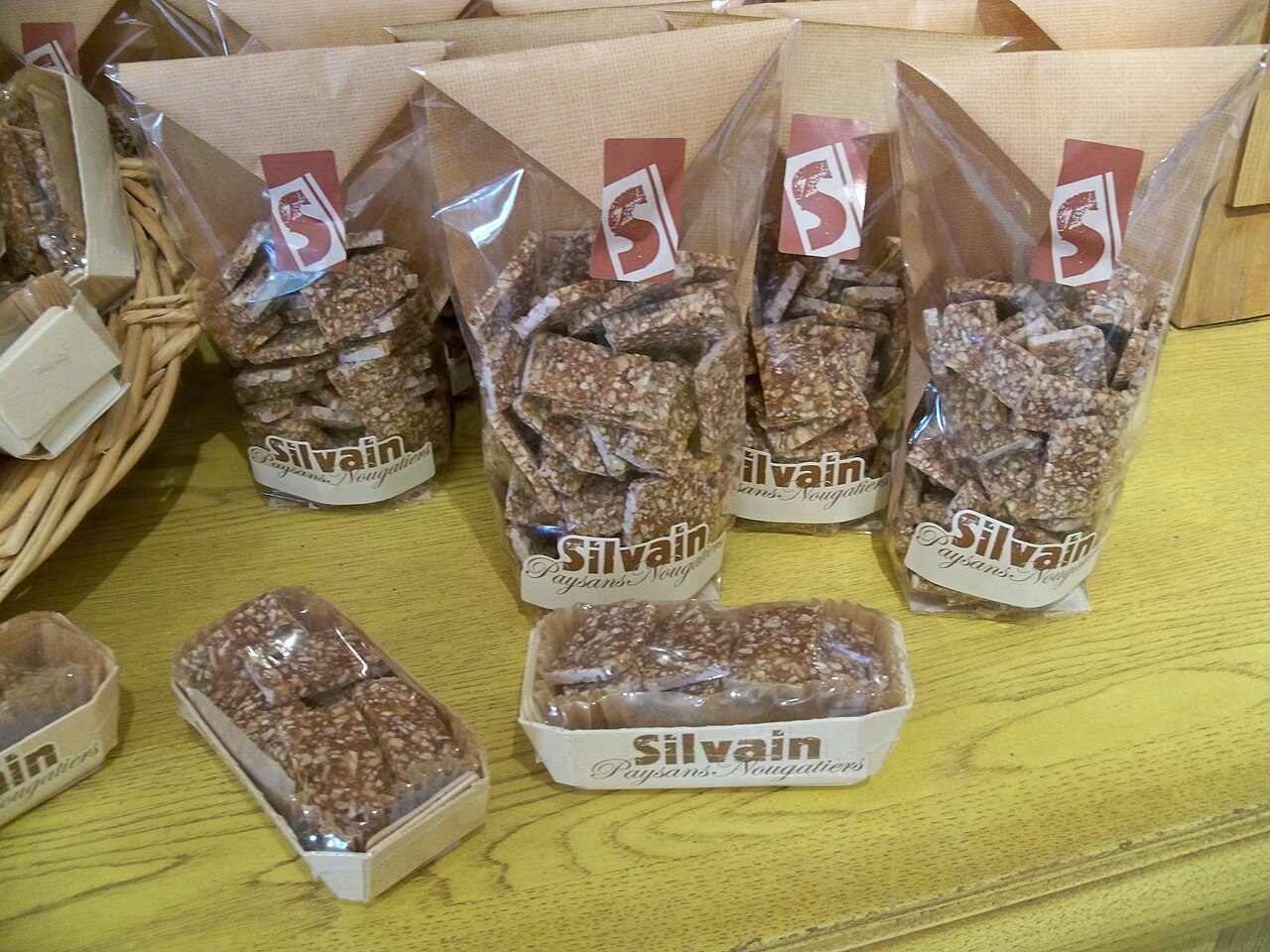
Nougat was traditionally eaten at Christmas, though less exclusively now.  Provence is famous for this, though a town famous for the production thereof (Montélimar) is just outside Provence.  Nougat is the soft variety (with eggs) and nougatine is the hard variety (without).  There are also white and black varieties: - hazelnuts, pine nuts or pistachios with white nougat and almonds and honey with the black.  Bilal loves nougat, as he likes sweet foods, but his coeliac disease limit his options (nougat being one).


Mendiants traditionally accounted for 4/13 of the desserts, the colours representing the gowns worn by the 4 separate monastic orders: dry figs (Franciscans), almonds (Carmelites), raisins (Dominicans) and hazelnuts (Augustinians).  There is a chocolate variant where one of each is put on top of a chocolate disc.  If I make them, I deliberately do numbers other than four, given our distaste for the Church of Rome.


Dates (representing Christ's eastern origins) are common and often stuffed with almond paste.  Another option for Bilal: - almond flour is a good substitute for wheat flour in cakes.  Quince paste and other fresh fruits are common, depending on local availability.


We had a very traditional Provençal Christmas, save for the exceptions mentioned.  Bilal is slowly warming up to this, given his family's traditional calendar.  Bilal wanted to celebrate Christmas more, but his parents made this difficult.  Now he is living with me, he is not subject to the same familial pressures.  He invited family members to join us: - naturally, they refused, just as we did with their Eid celebrations.  They find it difficult to accept that Bilal's new life with me and our son living away from their family home means it is harder to apply familial pressure.  In spite of all this, we had an absolutely fantastic first Christmas with our son and I look forward to many more traditional Provençal Christmases with Bilal and our children by our sides.

2016-12-30

LGVs due to be opened this coming year

Looking forward to 2017, I thought I would do a blog post covering the LGVs (Lignes à Grande Vitesse) that are due to open during 2017.  As many readers will be aware, France has an absolutely fantastic LGV network.  It contains one of only two lines to recoup its own building costs (Paris-Lyon, the other being Tokyo-Osaka).


They have made several journeys much easier.  For instance, I just adore visiting Reims (silly English people think it is pronounced "raymz", whereas "ranz" would be a better approximation), where French kings tended to be crowned.  Thanks to the LGV Est, it can be reached via an interchange at Marne la Vallée-Chessy or Aeroport Paris-Charles de Gaulle TGV stations and Gare de Champagne-Ardenne TGV station (served by both TER trains and a local tram network).


Our pinko-liberal commie socialist president (who has thankfully announced he isn't standing next year) delayed the construction of several lines, but several of the lines already in construction before he entered office are due to enter service in 2017, in addition to the 2nd phase of the LGV Est that opened earlier this year.  The lines are the LGV Bretagne-Pays de la Loire, the LGV Sud-Europe Atlantique and the Contournement Nîmes Montpellier, which I will briefly discuss in turn.


The LGV Bretagne-Pays de la Loire will go from the LGV Atlantique's current terminus near Le Mans to Rennes, expediting train journeys to various stations in Brittany.  Mireille Guiliano says her husband Edward notes the similarities there with England (not exactly to its credit, but anyway).  Just like Mireille, I love the seafood available in Brittany.  Yes, various fish products can be caught near Marseille, but Brittany has a very long coastline and different fish.  As per custom for new passenger-only lines, the line will open with an initial top speed of 320km/h, electrification of 25kV 50Hz and TVM300 (Transmission-Voie-Machine) and ERTMS Level 2 signalling.  The line will have several links to the conventional lines.  Some examples of journey time reductions are: -

  • Paris-Rennes 1h26m (from 2h05m)
  • Paris-Nantes 1h52m (from 2h09m)
  • Paris-St Malo 2h14m (from 2h54m)
  • Paris-Lorient 2h56m (from 3h43m)
  • Paris-Brest 3h25m (from 4h18m)

The LGV Sud-Europe Atlantique will go from the line's current terminus near Tours, where through trains are already able to bypass the city.  From there, it will continue to Ambarès-et-Lagrave (twinned with Norton Radstock, possibly the most gormless and rubbish town in the whole of the UK), which is on the outskirts of Bordeaux, the main urban centre in a region known for its fine wines: - I therefore just adore visiting the city, though this line will not do much to expedite journeys there from Marseille (the Bordeaux-Toulouse section of the GPSO will).  The line will have no new stations, but will have links to the existing intermediate stations on the conventional networks in Châtellerault, Poitiers and Angoulême.  The bypass will allow trains not stopping in these places to proceed full speed ahead to Bordeaux.  The line will be useful for people travelling not just to Bordeaux, but it will also appreciably shorten train journeys to Toulouse and Irún (over the border in Spain, plus the intermediate cities).  This will be particularly useful regarding Toulouse, as the air route between Paris-Orly and Toulouse-Blagnac airports is the busiest in Europe.  Paris-Bordeaux journey times will drop from 3h11m (non-stop) to about two hours.  The line will have an initial maximum speed of 320km/h, with the same power and signalling arrangements as the above lines.


The Contournement Nîmes-Montpellier will bypass Nîmes and allow freight traffic to avoid the centre of Montpellier.  It was decided that the existing Montpellier-St. Roch station would not be able to cope with the increased rail traffic, so the decision was made to build Montpellier-Sud de France station (which will unfortunately not have a tram link until 2020).  The line will bypass the centre of Montpellier, but bring Paris-Montpellier journeys down to about three hours.  It will have an initial operating speed of 220km/h, pending a signalling upgrade, which will allow it to be raised to 300km/h.  The reason for the slightly lower speed is the fact that this line is being designed to accommodate freight traffic, which results in a trade-off between gradients, cants and curvatures (curvature sacrificed for the other two parameters).  It will result in journey time reductions of around 20 minutes for journeys between Paris and Montpellier/Barcelona (and other intermediate destinations), though other train routes, such as the Intercité Bordeaux-Marseille may also use the line.  Bilal enjoys travelling by train to Seville to visit his homies and is learning Spanish (he is apparently doing a good job at mimicking hip-hop Spanish).  When the Nîmes-Perpignan gap is closed, it will be high-speed all the way from Marseille to Seville: - the route for the Montpellier-Perpignan section has been decided.  The power supply will be the same, but the initial signalling will be BAL (Bloc Automatique Lumineux) classique and ERTMS, both Level 1.


2017 looks like it will be a good year for high-speed train travel in France.  Spain's high-speed projects have more or less ground to a halt: - I wonder if we might have caught up with them by the end of 2017 in terms of kilometres of high-speed routes?